The Process: Cloning is done in three ways
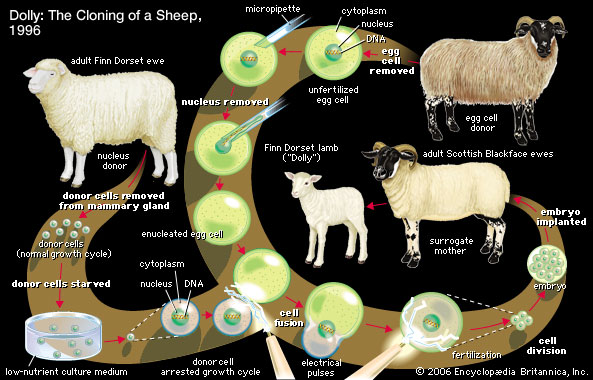
Reproductive Cloning: Makes an animal that is the same exact copy of a animal that is still living or has died. Reproductive Cloning is done by Somatic Cell Nuclear Transfer or Artificial Embryo Twining. Somatic Cell Nuclear Transfer: In this process, the nucleus of a somatic cell is placed into a egg cell. This egg cell's nucleus is removed. The egg cell and somatic cell are either put in a chemical solution or shocked with electricity so they fuse together. These cells are left to develop to a certain stage and then transferred to a female's uterus where it develops untill it is born. There are two different techniques used for Somatic Cell Nuclear Transfer: The Roslin Technique: This technique was developed by reasearchers at the Roslin Institue where they used it to create Dolly the first cloned sheep from adult cells. The somatic cells in this process are allowed to grow and divide. Then they are not given nutrients and enter the dormant stage. A egg cell with no nucleus is put beside this dormant somatic cell and shocked with electricity. The somatic cell fuses with the egg cell and they grow into an embryo cell and is placed into a surrogate mother. The Honolulu Technique: Developed by Dr. Teruhiko Wakayama, the egg that has been implanted with the nucleus from the somatic cell is bathed in a chemical solution and cultured. Then it is implanted in the surrogate mother. Artificial Embryo Twining is basically mimicking the natural process of making twins. The only difference is that this process is done in petri dishes. This process is carried out by a early stage embryo being seperated into individual cells and allowed to develop on their own. Then they are put into the surrogate mother where they are carried and delivered. The two cells are same exact copies of each other because they started out from the same cell. Terms: Somatic Cell: Any type of cell in the body Surrogate: A Substitute
 Therapeutic Cloning: Therapeutic cloning uses embryos that are destroyed in the process. The goal of this type of cloning is to study human development with the stem cells. This will help scientists to treat diseases. The first step in this process is to take the stem cell out of the embryos. They are taken out of the embryo when the embryo has divided for five days. The extraction is what destroys the embryo which causes so much controversial issue because some people see it as taking a life. Terms: Stem Cell: A cell that can be specialized into any type of cell in the body DNA Cloning: DNA cloning is transferring a DNA fragment into a organism that replicates by itself. One example of an organism that replicates itself is a bacteria. This process starts with using restriction enzymes to get the desired DNA from the chromosome. Then the plasmid inside the bacteria is cut up with the same restriction enzyme used for the desired DNA. The DNA is then joined with the plasmid and the bacteria can start replicating with the DNA inside it. Terms: Restriction Enzyme: An enzyme that cuts up chromosomes at a specific sequence Plasmids: Self-Replicating DNA molecules Cloning Impacts: |
||||
SOCIAL IMPACTS:
Translate This Page |
ECONOMIC IMPACTS:
We never really hear what the Biotech Companies are doing. What are they cloning or making? To find out what a few Biotech Companies did click on the link below.  |
POLITICAL IMPACTS:
Is funding for human cloning banned or is it legal? So whats the deal? Click on the link below to find out. They are going to support CLONING?! Click on the links below to find out.  |
||
